
A dietitian’s take on the science behind the 2025-2030 Dietary Guidelines for Americans
By María G. Sanabria-Véaz, RD
The start of the new year brings hope for what’s to come. Earlier this year, the Dietary Guidelines for Americans 2025-2030 were released, raising concerns among healthcare professionals and scientists. In this piece, I will comment on key changes, contradictions, and implementation concerns of the guidelines from a dietitian’s perspective.
What are the Dietary Guidelines for Americans (DGAs)?
The Dietary Guidelines for Americans (DGAs) are evidence-based recommendations to meet nutrient needs, reduce chronic disease, and promote health across all life stages (1,2). They are written for policymakers, healthcare providers, and federal nutrition programs. An expert advisory committee addresses questions relevant to nutrition through (1) systematic reviews, (2) dietary pattern analysis, or (3) food pattern modeling to assess health outcomes (1,3). The committee then prepared a scientific report that the US Department of Agriculture (USDA) and the Department of Health and Human Services (HHS) use to develop the guidelines. These are implemented at both the federal (e.g., National School Lunch Program) and individual (e.g., MyPlate) levels.
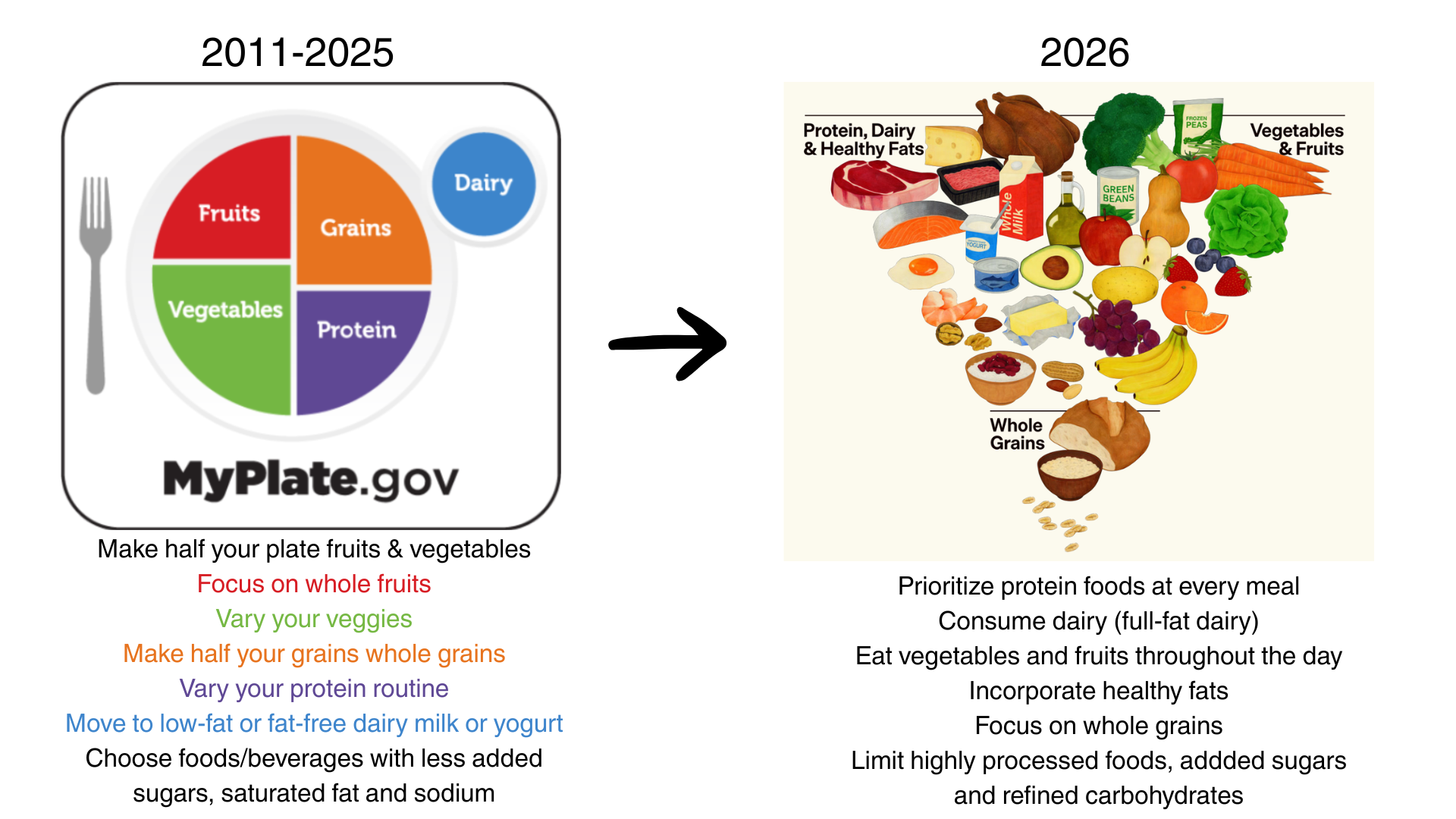
Figure 1. Visual representation of dietary guidelines from 2010-2025 (A) and 2025-2030 (B). Visual educational tools to translate the science from the dietary guidelines to consumers and governmental agencies. MyPlate (A) served as the primary educational resource from 2010 to 2025, focusing on the distribution of food groups within each meal plate. The new dietary guidelines (2025-2030) (B) use an inverted pyramid highlighting animal protein, fruits, and vegetables at the top, and shifting whole grains to the bottom.
Recommendation for more protein: hype or science?
A notable change in this edition (4) is the recommendation to increase protein intake from 0.8 to 1.2-1.6g/kg/day. It emphasizes protein foods from animal sources, including eggs, poultry, seafood, and red meat, as well as plant-sourced proteins. The previous recommendation (0.8g/kg/day) was determined based on metabolic endpoints (e.g., nitrogen balance), rather than health outcomes (5,6). Indeed, higher protein intake is associated with improvements in strength, lean body mass, bone mineral density, and physical function (5), particularly in older adults (5,6).
To maximize these benefits, exercise is necessary (7). Imagine that exercise is the machine you need to make ice cream (muscle mass). Heavy cream (dietary protein) is an important ingredient, but the cream alone doesn’t make ice cream - you need the machine (exercise). Thus, exercise drives muscle mass synthesis, while dietary protein supports the process. Given the importance of exercise, the guidelines need information about exercise, especially when recommending a higher protein intake. For vegan diets, additional recommendations include emphasizing plant-based meat alternatives (e.g., soy), plant-derived protein isolates to enhance absorption, and complementary protein sources (e.g., rice and beans) (5).
Still, data from national surveys suggest that protein intake in adults is 1.11-1.25 g/kg/day of protein (8), well above the recommendation of 0.8g/kg/day. Contrary to the guidelines, the scientific report does not recommend increasing overall protein intake (1). It recommends moving the beans, peas, and lentils subgroup from the vegetable to the protein group to emphasize the benefits of plant-based proteins, while limiting intake of red and processed meats (1). This may increase intake of protein specifically from the beans, peas, and lentils group, not overall protein—an important distinction that is not present in the guidelines. Overall, protein intake should be accompanied by greater physical activity and a variety of protein sources, including leaner cuts of animal proteins and plant-based proteins.
Contradiction between saturated fat and recommended food sources
The guidelines recommend <10% of total daily calories from saturated fat, yet the recommended food sources somewhat contradict this. The “incorporate healthy fats” section lists fat from animal protein sources that are generally high in saturated fat first (meat, poultry, eggs), followed by healthier unsaturated fats such as omega-3-rich seafood, nuts, seeds, olives, avocado, and olive oil. It also includes full-fat dairy and cooking in butter and beef tallow as potential options when cooking with or adding fat to meals (4). In contrast, the scientific report rates as strong the evidence linking lower saturated fat and red meat intake with reduced cardiovascular disease risk (1). Similar recommendations are provided by the American Heart Association to lower saturated fats (butter, red meat) and replace them with polyunsaturated fats (omega-3 fatty acids, nuts, seeds) to reduce heart disease (9).
Let us not forget about dietary fiber - a nutrient of public health concern
Amid higher protein intake recommendations and inconsistent advice on saturated fat, dietary fiber deserves more attention than ever. Adults aged 19 to 50 consume only 14.8-17.5g/day of fiber (8), far below the recommendation (25-38g/day) (10). Dietary fiber is a group of non-digestible carbohydrates naturally found in plant foods (whole grains, fruits, vegetables, legumes) or obtained through distinct processing means (fiber supplements) (11). Dietary fibers enhance digestion and calcium absorption, and reduce LDL cholesterol, blood glucose, and blood pressure (12). Not surprisingly, dietary patterns rich in fiber are consistently associated with a lower risk of heart disease, cancer, and diabetes (13).
Similar to past guidelines, whole grain goals are 2-4 servings daily (4). However, the shift from MyPlate (14) to an inverted pyramid suggests otherwise, placing whole grains at the very bottom and red meat at the top next to fruits and vegetables (Figure 1). This contradicts the science consistently linking dietary patterns rich in red meat with increased cardiovascular disease risk (1,2). The inverted pyramid's messaging may further worsen inadequate fiber intake. Thus, plant-based proteins (beans, peas, lentils, soy, and nuts) can help meet both fiber and protein recommendations and better reflect the science and written guidelines (see proposed inverted pyramid from a dietitian’s perspective, Figure 2).
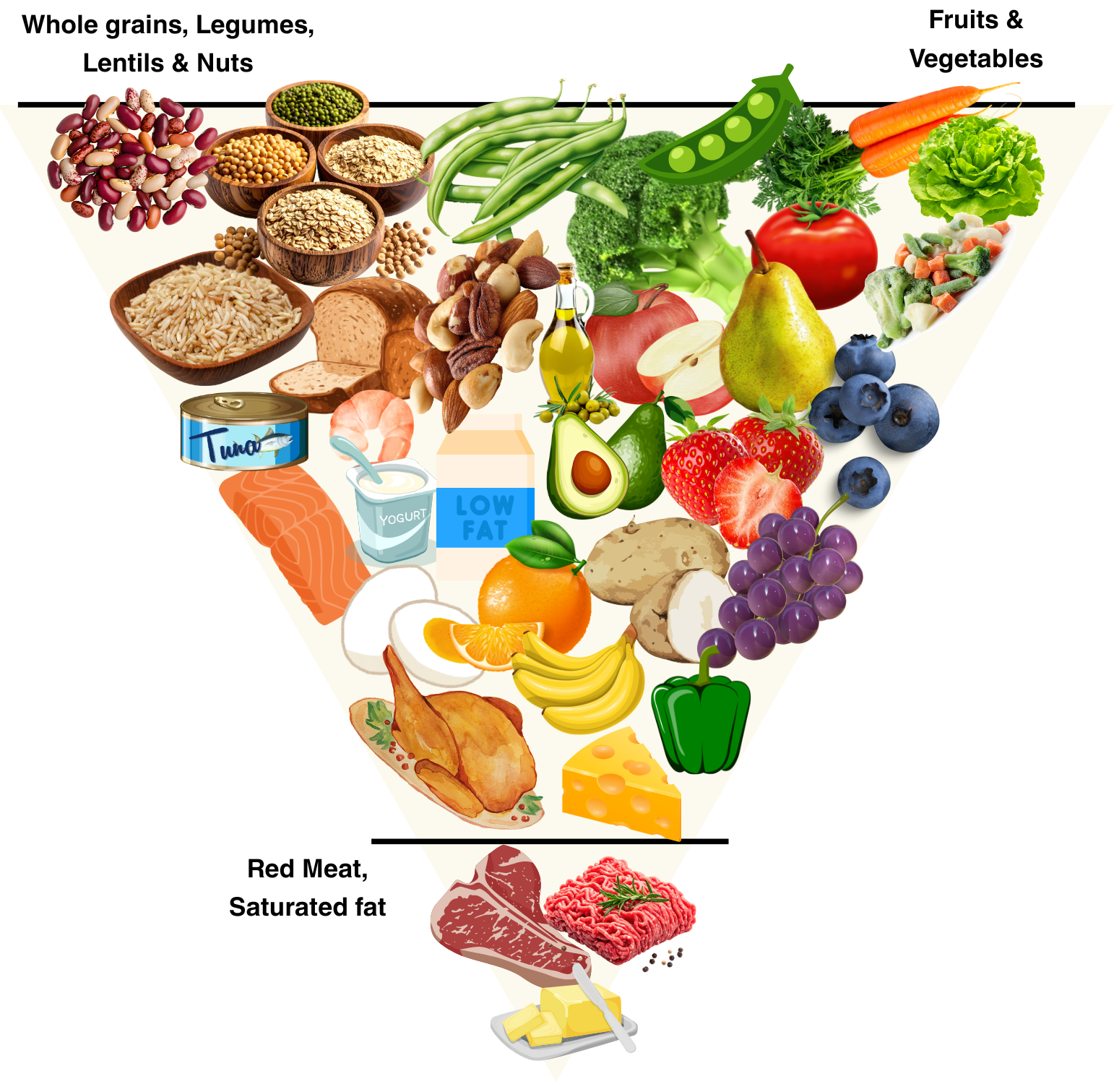
Figure 2. Modified inverted pyramid from a dietitian’s perspective. This modified inverted pyramid incorporates conclusion statements from the 2024 scientific report conducted by the guidelines’ advisory committee. Red meat and saturated fat (e.g., butter) were moved to the bottom, and legumes, peas, lentils, and nuts were placed at the top, next to fruits and vegetables, to highlight the benefits of plant-based proteins. Seafood, fish, leaner cuts of meat, and low-fat dairy are prioritized over red meat and full-fat dairy.

Figure 3. Health equity: the state in which everyone has a fair and just opportunity to attain their highest level of health. The 2024 scientific report incorporates a health equity perspective into data analysis and dietary recommendations, considering the structural, societal, and cultural factors that shape access to health care. Intervention approaches that consider health equity can be more effective at improving adherence to dietary guidelines.
“Eat real foods” by limiting highly processed foods: Can we really do it?
This edition takes a strong stance against highly processed foods: refined carbohydrates, salty/sweet snacks, and sugar-sweetened beverages. This aligns with increased restrictions on added sugars to <10 g per meal. Highly processed foods are usually high in empty calories and low in nutrients, but not all processing is bad (e.g., pasteurizing milk, shredding carrots). The guidelines should reinforce this important distinction. Furthermore, the emphasis in the guidelines is on real foods and home-cooked meals, which don’t consider structural barriers like the cost differential between whole foods and highly processed alternatives (15).
This raises a broader issue—differences in social, racial, economic, and cultural backgrounds that influence health outcomes. This year, the committee acknowledged health equity (Figure 3), “the state at which everyone has a fair and just opportunity to attain their highest level of health,” (1) and the environmental conditions in which people live, work, learn, and age, as part of the scientific report. Education-based interventions about the guidelines alone only address a small part of the picture. Policy-level interventions, such as improving access to whole foods, modifying the food supply (e.g., lowering sodium (1)), and building communities that promote active lifestyles, are urgently needed to improve adherence to the guidelines.
Concluding remarks
The changes discussed here were examined alongside the literature and the 2024 scientific report. Overall, higher protein intake is beneficial, but it should be coupled with exercise and leaner cuts of animal protein and plant-based protein. Dietary fiber remains a nutrient of public health concern (1) and should be prioritized in plant-based foods. Lastly, recommending eating real foods is certainly valuable, but it must be paired with education on food processing and policy-level interventions to ensure equitable implementation and access.
References
1. US. Department of Health and Human Services & US. Department of Agriculture. Scientific Report of the 2025 Dietary Guidelines Advisory Committee: Advisory Report to the Secretary of Health and Human Services and Secretary of Agriculture. (2024) doi:10.52570/DGAC2025.
2. U.S. Department of Agriculture & U.S. Department of Health and Human Services. Dietary Guidelines for Americans, 2020-2025. DietaryGuidelines.gov (2020).
3. Snetselaar, L. G., de Jesus, J. M., DeSilva, D. M., & Stoody, E. E. Dietary Guidelines for Americans, 2020-2025: Understanding the Scientific Process, Guidelines, and Key Recommendations. Nutr. Today 56, 287–295 (2021).
4. U.S. Department of Agriculture, U.S. Department of Health and Human Services. Dietary Guidelines for Americans, 2025-2030. https://cdn.realfood.gov/DGA.pdf (2026).
5. Matthews, J. J. et al. Understanding Dietary Protein Quality: Digestible Indispensable Amino Acid Scores and Beyond. J. Nutr. 155, 3152–3167 (2025).
6. Phillips, S. M., Chevalier, S. & Leidy, H. J. Protein “requirements” beyond the RDA: implications for optimizing health. Applied Physiology, Nutrition, and Metabolism 41, 565–572 (2016).
7. Greyvenstein, D., Newbold, J. P. & Phillips, S. M. Tension to Translation: External to Internal Processes in Muscle Hypertrophy. Physiology 41 (2026).
8. USDA, A. R. S. Usual Nutrient Intake from Food and Beverages, by Male/Female and Age, What We Eat in America, NHANES 2017-March 2020 Prepandemic. http://www.ars.usda.gov/nea/bhnrc/fsrg (2023).
9. Sacks, F. M. et al. Dietary Fats and Cardiovascular Disease: A Presidential Advisory From the American Heart Association. Circulation 136, (2017).
10. Gropper, S. S., Smith, J. L., & Carr, T. P. “Fiber” in Advanced Nutrition and Human Metabolism. Vol. 2 107–121 (Cengage Learning, Boston, 2017).
11. McCleary, B. V. Measurement of Dietary Fiber: Which AOAC Official Method of Analysis SM to Use. J. AOAC Int. 106, 917–930 (2023).
12. Food and Drug Administration. Scientific Evaluation of the Evidence on the Beneficial Physiological Effects of Isolated or Synthetic Non-Digestible Carbohydrates Submitted as a Citizen Petition (21 CFR 10.30): Guidance for Industry. https://www.fda.gov/media/101183/download (2018).
13. Ramezani, F. et al. Dietary fiber intake and all-cause and cause-specific mortality: An updated systematic review and meta-analysis of prospective cohort studies. Clinical Nutrition 43, 65–83 (2024).
14. USDA. History of Dietary Guidance Development in the United States – A Timeline. https://www.dietaryguidelines.gov/history
15. Du, N. & Abrams, S. A. The 2025–2030 dietary guidelines for Americans: a pediatric review of recommendations for children under 5 years. Am. J. Clin. Nutr. 123, 101295 (2026).