How Do Probiotics Work? Moving from Microbiome Associations to Mechanism Exploration with Vagina-on-a-Chip Technology
By Andreea-Monica Marin
My PhD topic: Understanding how beneficial vaginal bacteria support pregnancy
My fascination with the vaginal microbiome began during my master's thesis internship in the laboratory of Prof. Sarah Lebeer. There, I had the opportunity to explore the complex, and often underappreciated, microbial community of the reproductive tract by analyzing longitudinal vaginal microbiome and clinical data from pregnant women.
What started as a research project quickly became a source of motivation. Through this work, I gained insight into how vaginal microbiome composition and specific bacterial taxa are linked with pregnancy outcomes and just how much remains unknown about the biological mechanisms linking the vaginal microbiome to inflammation and eventually preterm birth. Even contributing a small piece to this puzzle felt meaningful, given the significant health burden associated with pregnancy complications, especially preterm birth (incidence rate of 8% wordwide, WHO 2020).
This experience ultimately shaped my decision to pursue a PhD. I was given the opportunity to build a research project (funded by Research Foundation – Flanders, FWO) around a question that surfaced repeatedly in both the literature and my own analyses: why are certain vaginal bacteria consistently associated with full-term pregnancies, while others are linked with preterm deliveries?
A growing body of evidence suggests that beneficial vaginal bacteria help maintain a low-diversity, acidic, and immunologically balanced environment that is less permissive to pathogen overgrowth and excessive inflammation. Among these bacteria, Lactobacillus crispatus stands out as one of the species most consistently associated with healthy, full-term pregnancies.
As part of my PhD, I am leading the microbiome analyses of the PRIORI clinical trial, which evaluates a synbiotic containing L. crispatus administered to pregnant women at high risk of preterm birth. This offers a unique opportunity to investigate whether microbiome-based interventions can support maternal health during pregnancy and which bacteria are associated with positive pregnancy outcomes in a high-risk cohort.
At the same time, my research goes beyond associations. I am particularly interested in understanding the biological mechanisms that underpin the beneficial effects of vaginal lactobacilli. To do this, I study how Lactobacillus strains isolated from healthy women interact with both vaginal pathogens and host cells. Can these strains inhibit microorganisms linked to vaginal dysbiosis? Can they modulate inflammatory pathways associated with adverse pregnancy outcomes? Answering these questions could help bridge the gap between microbiome observations and the development of evidence-based probiotic strategies.
Why we need better models: Enter the vagina-on-chip
A critical aspect of studying potential probiotic bacterial strains is choosing the right experimental model. Although animal models have contributed enormously to reproductive health research, they present important limitations for studying the vaginal microbiome and host–microbe interactions. Unlike humans, most animals do not naturally harbor Lactobacillus-dominated vaginal communities, making translation of findings challenging.
Traditional in vitro models, such as vaginal epithelial cell cultures and transwell systems, have helped bridge this gap by allowing researchers to investigate microbial interactions with host tissues under controlled conditions. However, these systems cannot fully reproduce the complexity of the vaginal environment, due to lacking dynamic flow.
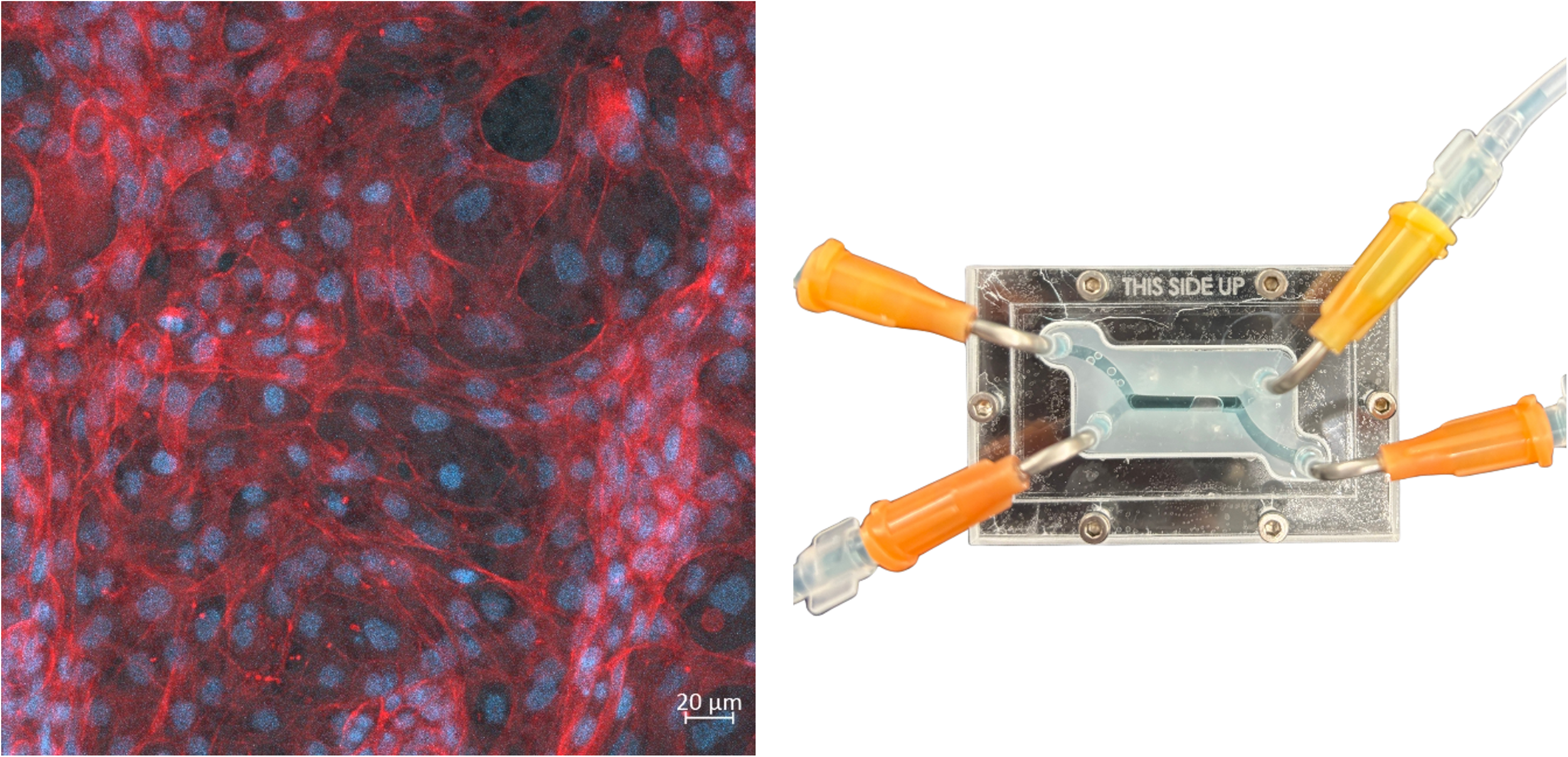
On the left, confocal imagining of Madin-Darby Canine Kidney (MDCKs, kidney cells) in monolayer, stained with Hoechst on the nucleus and Phalloidin on the cytoskeleton. On the right, the microfluidic device (insert inside the cassete) under dynamic flow. Pictures are taken by me while visiting the Gleghorn Lab.
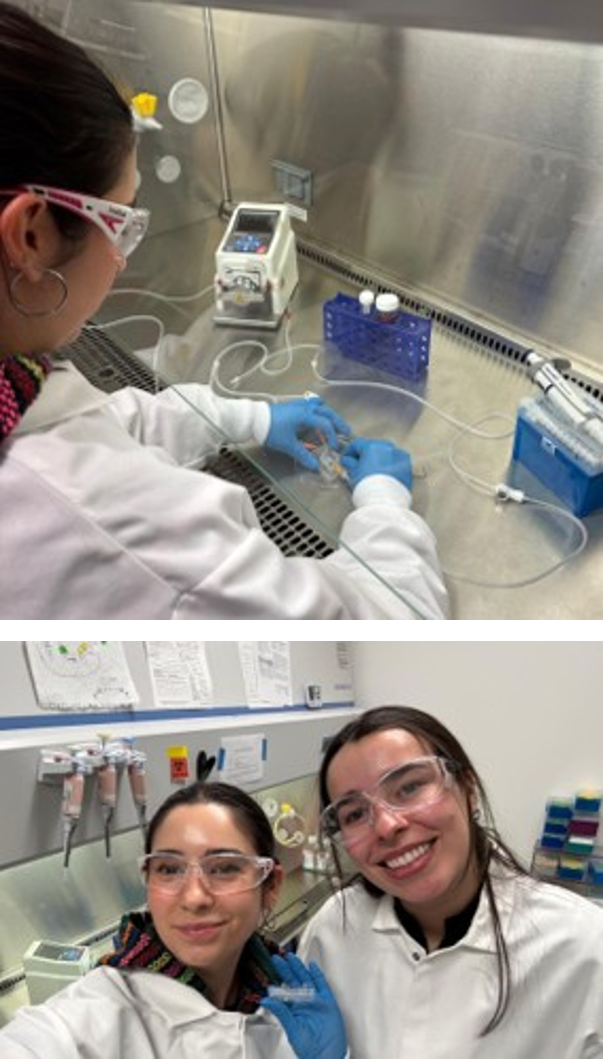
Above: technical training at Gleghorn Lab. Below: me and my amazing trainer, PhD student Filipa Ribeiro, posing with the innovative microfluidic device.
This is where organ-on-chip technologies come into play. Vagina-on-chip models recreate key features of human vaginal tissue, including a stratified epithelial layer, stromal support cells, and dynamic fluid flow. By better mimicking the structure and physiology of the human vagina, this platform provides exciting new opportunities to study host–microbe interactions in a more realistic setting than conventional two-dimensional cultures. They allow us to move beyond simply identifying beneficial bacteria and start investigating how they work.
A research stay focused on building the future
My interest in employing an advanced experimental model for my research ultimately led me to the laboratory of Prof. Gleghorn, at Delaware University, for a research stay funded by the Research Foundation – Flanders (FWO). The main goals were twofold: to establish an academic collaboration and gain hands-on expertise that helps introduce vagina-on-chip technology (see detailed picture of the chip) into our research group back in Belgium.
During my stay, I received training in the technical aspects of the model, beginning with culturing MDCKs and seeding them into the microfluidic platform. The device consists of an apical epithelial channel and a basal fibroblast channel separated by a porous membrane coated with fibronectin, allowing cells to grow in an environment that more closely resembles native tissue architecture.
A significant part of the experience involved troubleshooting and optimization. We tested membrane permeability using fluorescent dextran, characterized tissue formation through confocal microscopy (see picture of confocal imagining) and learned to maintain cultures under continuous fluid flow. These dynamic culture conditions are particularly exciting because they help recreate aspects of the vaginal ecosystem and physiological conditions that static cell cultures cannot capture.
Looking ahead: bringing the model home
Returning to Belgium, I came back with a clear goal: adapting and optimizing the vagina-on-chip platform within our own laboratory environment and integrating it into my PhD research.
As anyone working with emerging technologies knows, not every day in the lab goes according to plan. Yet these challenges are among the most valuable parts of the experience, teaching me both the technical skills and the problem-solving mindset required to implement a new model system. The lucky part is that Gleghorn’s lab team is always one call away and ready to troubleshoot with me.
The next step is to introduce the selected vaginal Lactobacillus strains into the system and investigate their interactions with host tissues and dysbiosis-associated microorganisms. For me, this is where the project becomes especially exciting. The model offers an opportunity to study potential probiotic mechanisms in an environment that more closely reflects the human vagina, bringing us one step closer to translating laboratory findings into clinically relevant applications.
International mobility as a pillar of scientific growth
Beyond the scientific advances, the research stay was also a reminder of the core value of international mobility in science. The research group brought together scientists from diverse cultural and academic backgrounds, creating an environment where ideas, perspectives, and expertise could be exchanged freely.
International experiences have been a recurring theme throughout my academic journey. Originally from Romania, I completed my bachelor's degree in Bucharest, pursued a master's degree in the Netherlands, and am now conducting my doctoral research in Belgium. Each move has expanded my scientific network, challenged me to adapt, and exposed me to new ways of thinking about research.
Progress in probiotic research depends not only on innovative technologies and robust clinical studies but also on collaboration across institutions, disciplines, and countries.